Repairs
Why doors stick in summer, and how to fix them for good
A door that closed fine in winter and now rubs or won't latch is usually down to humidity, hinges or movement. Here's how to work out which, and what the fix involves.
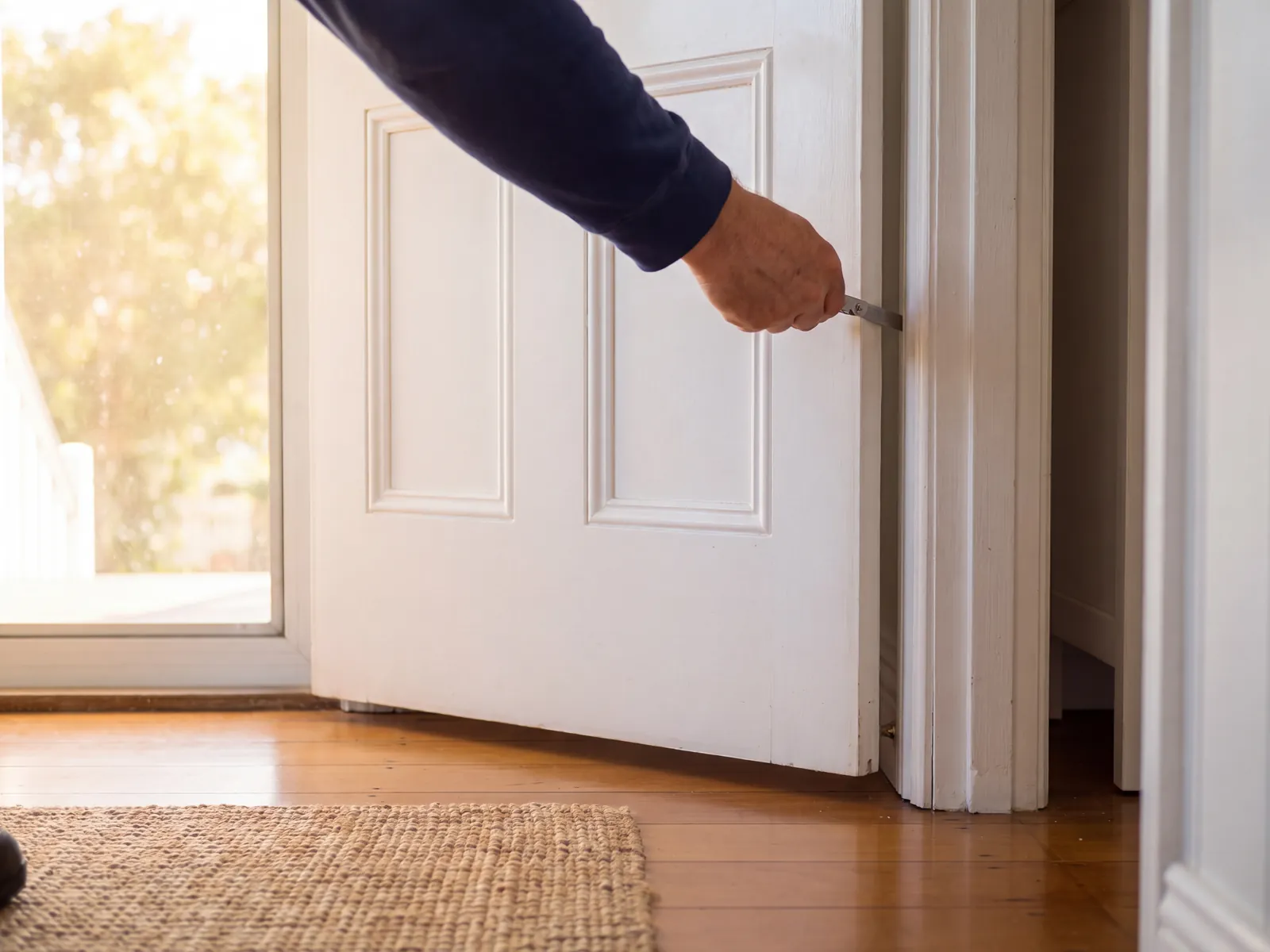
Every summer the same calls come in: a bedroom door that won't shut, a front door you have to shoulder open, a laundry door that rubs at the top. In most homes on the Gold Coast and in Brisbane, the cause is one of a handful of things, and a few of them you can check yourself in five minutes.
Cause 1: the timber has swollen
Timber takes up moisture from the air and gives it back again. In a humid Queensland summer, a door can grow just enough to start rubbing, then shrink back in winter. Most doors are sealed with paint on their faces, but the top and bottom edges often aren't. Doors are frequently trimmed to fit when they're hung, and if nobody paints the cut edge, it soaks up moisture much faster than the rest of the door.
Check by opening the door and looking along the top and bottom edges with a torch or a phone camera. Bare timber there is a strong clue.
Cause 2: loose hinge screws
This is the most common cause we find, and the easiest fix. The top hinge carries most of the door's weight. When its screws loosen, the door drops on the latch side and the top corner starts rubbing on the frame. Open the door, hold the handle and lift gently. If the door moves up and down at the hinge, that's your problem.
Tighten the screws first. If they just spin, the holes are stripped. A longer screw through the top hinge into the wall framing behind the jamb usually pulls the door back into line and holds it there.
Cause 3: the house has moved
Houses move a little with the seasons. Much of South East Queensland sits on reactive clay soil, which swells when it's wet and shrinks when it's dry. That movement can push door frames slightly out of square, which is why a door that was perfect in winter can bind after weeks of summer rain. Older Brisbane Queenslanders on stumps move too, as stumps settle and timber framing ages.
Small seasonal movement is normal. But watch for a pattern. If several doors start sticking at once, and new cracks appear in the walls, especially diagonal cracks from the corners of doors and windows, get a building inspector or structural engineer to look at it before anyone starts planing doors. We cover what different cracks mean in our guide to plaster cracks.
Cause 4: layers of paint
A door and frame that have been repainted many times can simply run out of gap. Each coat adds thickness to the door edge and the stop beads, until there's nowhere left to go. It's common in older homes and usually shows as rubbing along the whole latch side.
Cause 5: it closes but won't latch
Sometimes the door swings fine but won't click shut. That's usually the latch and the strike plate on the frame no longer lining up, often because of a small drop at the hinges or movement in the frame. Look for fresh scratch marks above or below the strike plate. A strike plate adjustment or a hinge fix normally sorts it out; it doesn't mean you need a new lock. Our locks and handles service covers latch adjustments like this.
How to find exactly where it rubs
- Close the door slowly and watch the gap all the way around. A good door has an even, narrow gap at the top and sides.
- Look for shiny or worn spots in the paint on the door edge and the frame. That's where it's rubbing.
- Slide a piece of paper around the gap with the door closed. Where it jams, the door is touching.
- Check the hinge side. A gap that's tight at the top hinge and wide at the bottom points to loose screws.
Fixing it properly
The order matters. We always start with the hinges, because a door that's dropped will keep rubbing no matter how much you take off it. Once the hinges are tight and the door sits right, we look at whether the frame needs packing or adjusting.
Only then do we plane, and only as much as needed. Taking a lot off a door at the height of a humid summer is a common mistake, because when it dries out in winter you're left with a big gap that rattles and lets in light and draughts. After planing, the bare edge has to be sealed straight away with primer and paint, or the door will swell again and you're back where you started.
Sliding doors stick too
Cavity sliding doors and wardrobe sliders are just as affected by summer humidity, plus they have tracks and rollers that collect dust, hair and grit. If a slider has started dragging, scraping or jumping off its track, it's often the rollers or the track rather than swelling. That's a different repair, covered by our sliding door repairs.
When to call a carpenter
Tightening hinge screws is a fine DIY job. Planing a door evenly, resetting hinges, packing a frame or rehanging a heavy front door is where a carpenter saves you time and a damaged door. We fix sticking, rubbing and swinging doors across the Gold Coast and Brisbane, and we reseal every edge we touch.
If your door has started playing up, send us a photo or short video of it opening and closing, plus your suburb. We can usually tell from that what's going on, and we'll come back with a quote.