Buying guides
Merbau vs spotted gum vs composite: choosing decking in Queensland
All three make good decks in Queensland. The right one for you depends on the look you want, where the deck sits and how much upkeep you're happy with.

When people ask us what to build a deck from, the short list is nearly always the same: merbau, spotted gum or composite. All three can make a great deck on the Gold Coast or in Brisbane. They differ in look, how they behave around pools and in the sun, and how much looking after they need.
Merbau
Merbau is an imported tropical hardwood with a rich red-brown colour and a fairly even look from board to board. It's hard-wearing, stable and well suited to decks, which is why it's been a favourite in Queensland for years. It's also a timber we often use for pool decks.
- Looks: warm red-brown that weathers to silver-grey if it isn't oiled
- Stability: moves less than many hardwoods, so boards stay flatter
- The catch: merbau bleeds a lot of tannin when new. Rain washes red-brown stain onto concrete, render, pavers and pool coping, so nearby surfaces need protecting for the first few weeks
- Sourcing: it's an imported rainforest timber, so ask your supplier about certified sources
Spotted gum
Spotted gum is an Australian native hardwood grown in Queensland and New South Wales. It's very hard and dense, with colours ranging from pale grey-brown to deep chocolate, often in the same pack. Some people love that variation; others prefer the more uniform look of merbau.
- Looks: varied colour with a distinctive wavy grain
- Strength: harder and heavier than merbau, and holds up well to heavy use
- Tannin: bleeds some, but generally much less than merbau
- Movement: can move more than merbau, so good installation and spacing matter
Composite
Composite decking is made from a blend of wood fibre and plastic, often with a hard outer shell. It never needs oiling, and it won't splinter or rot. That makes it attractive to people who want a deck without the upkeep.
- Looks: consistent colour and texture, with many shades to choose from
- Maintenance: a regular wash rather than oiling. Dirt and mould can still grow on the surface in humid weather, so it does need cleaning
- Heat: composite can get hotter underfoot than timber in direct sun, especially darker colours. That matters around pools and for bare feet
- Repairs: deep scratches can't be sanded out the way timber can
- Installation: every brand has its own rules for joist spacing, gaps and fixings, and they're often stricter than for timber. Following them is usually a condition of the product warranty
Around pools
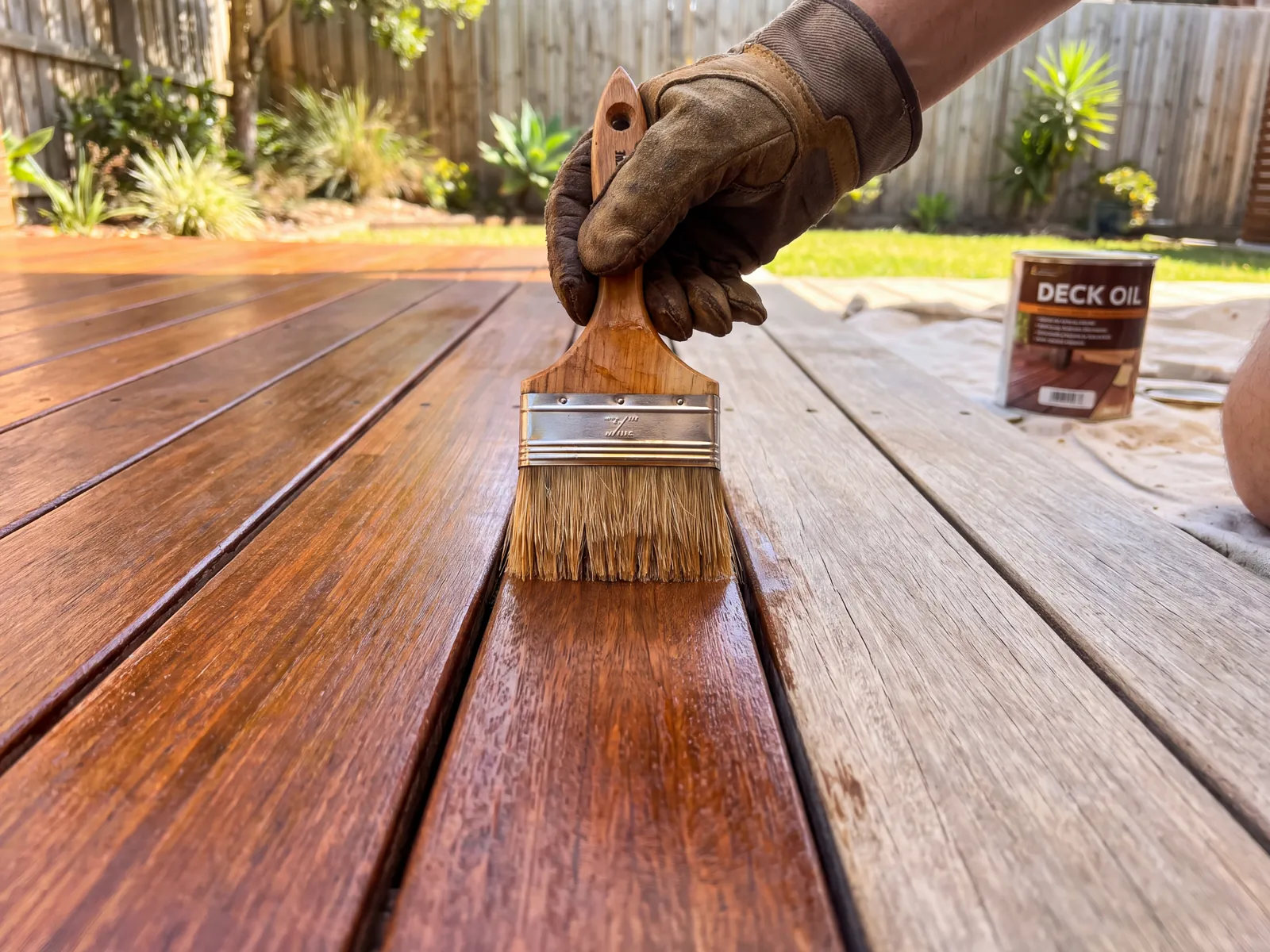
Pool decks get wet, dry out, get wet again, and are walked on barefoot. Hardwood stays cooler underfoot than many composites, but needs regular oiling because of the constant wetting. If you choose merbau next to a new pool, plan for the tannin: keep the coping and paving hosed down after rain until the bleeding settles, and make sure the deck is cleaned before it's oiled. With composite, ask for a lighter colour and check the manufacturer's guidance for pool surrounds.
Near the coast
Salt air doesn't hurt merbau, spotted gum or composite much, but it attacks the wrong fixings. On canal-front and beachside decks, use marine-grade stainless steel screws and hardware, and rinse the deck with fresh water now and then. With hardwood, expect a little more maintenance on the sides that face the water and the wind.
The frame matters more than the boards
Whichever board you choose, a deck is only as good as the subframe underneath. That means the right size and spacing of joists and bearers, framing protected from ground moisture, good ventilation under the deck, and a fall so water runs off. If you want composite on an existing timber deck frame, the joist spacing has to match the composite maker's requirements, which sometimes means adding joists. Higher decks or decks attached to the house in certain ways may also need building approval; we'll tell you if yours does.
Quick comparison
- Lowest upkeep: composite, followed by either hardwood with a regular oiling routine
- Coolest underfoot in full sun: hardwood
- Most uniform colour: composite, then merbau
- Most natural variation: spotted gum
- Can be sanded and refreshed: merbau and spotted gum
- Tannin bleed: highest with merbau
So which one?
If you love the look of timber and don't mind an oiling routine, merbau or spotted gum both make excellent decks. Choose merbau for the classic even red tone, spotted gum for a natural Australian timber with more character. If you'd rather never pick up an oil brush, composite is worth a look, as long as you're comfortable with how it feels in summer sun.
Whichever you choose, our deck building service covers the frame, boards, steps and balustrades, and our deck care guide explains how to look after timber once it's down. Matching batten screens in the same timber can tie the whole area together.
If you're planning a deck, send us a few photos of the area and a rough size. We'll talk you through the options for your spot and quote it properly.