Care & maintenance
Timber deck care in Queensland: a step-by-step guide
Queensland sun, summer storms and salt air are hard on a timber deck. Here's how we clean, oil and check decks on the Gold Coast and in Brisbane so they last.
Why decks wear faster in Queensland
Strong UV breaks down the surface fibres of the timber, which is what turns a red merbau or brown spotted gum deck silver-grey. Humidity and summer storms keep the boards wet for long stretches, so mould grows and the timber swells and shrinks. And near the water, salt settles on the boards and fixings, holds moisture against them and speeds up rust on the wrong screws.
None of this makes timber a bad choice. A deck just needs a simple routine, done before the timber shows damage.
Step 1: clear the deck and check it over
Move furniture, pots and rugs, which trap water and leave dark rings. Sweep, then run a putty knife or thin scraper along the gaps between boards. Leaf litter packed into those gaps holds water against the board edges and stops the deck draining and drying after rain.
While it's clear, walk the deck slowly and look for:
- Soft or spongy spots, especially near the house, under pots and at board ends
- Screws or nails that have lifted above the surface
- Boards that have cupped, split at the ends or come loose
- Black stains around fixings, a sign of iron reacting with the tannins in the timber
- Balustrades, handrails or steps that move when you push on them
Soft timber and loose balustrades are repairs, not maintenance, so fix them before oiling. If you find mud tunnels on stumps or bearers, or timber that sounds hollow when you tap it, call a licensed pest controller first. We don't treat termites, but we replace damaged boards and framing once the pest controller has been.
Step 2: clean the boards
Oil only soaks into clean, open timber. Use a deck cleaner and follow its directions. Cleaners for grey timber and tannin stains are usually oxalic acid based; ones for mould and grime are often percarbonate based. Wet the boards, apply the cleaner, scrub along the grain with a stiff broom and rinse well.
A pressure washer is fine on low pressure with a wide fan nozzle, held well back and moving along the grain. Too close and it furs up the surface and gouges the softer growth rings.
Let the deck dry completely, which can take a couple of days in humid weather. Oil on damp timber won't soak in.
Step 3: sand only where it needs it
A well-kept deck rarely needs a full sand. Spot sand rough patches and splinters. If old coatings are flaking, or the deck has gone deeply grey and furry, a full sand back is usually the right call. Punch down lifted fixings first.
Step 4: choose oil, stain or paint
For a deck you walk on, we recommend a penetrating decking oil. It soaks into the timber instead of forming a skin on top, so it wears away gradually rather than peeling, and recoating is just another clean and oil.
- Clear oils: show the timber's natural colour, but give the least UV protection, so they need recoating most often.
- Tinted oils and stains: the pigment blocks more UV, so the colour holds longer and the boards grey more slowly. A good choice for decks in full sun.
- Film-forming finishes such as decking varnish or paint: they look great at first, but on a flat surface in Queensland sun they tend to crack and peel under foot traffic. Fixing that means sanding back to bare timber, so we don't recommend them for deck boards.
Step 5: apply the oil properly
- Pick a dry, mild day with no rain forecast for the drying time on the tin, and stir the tin well.
- Work early or late in the day, not in direct midday sun. Hot boards dry the oil before it soaks in and leave lap marks.
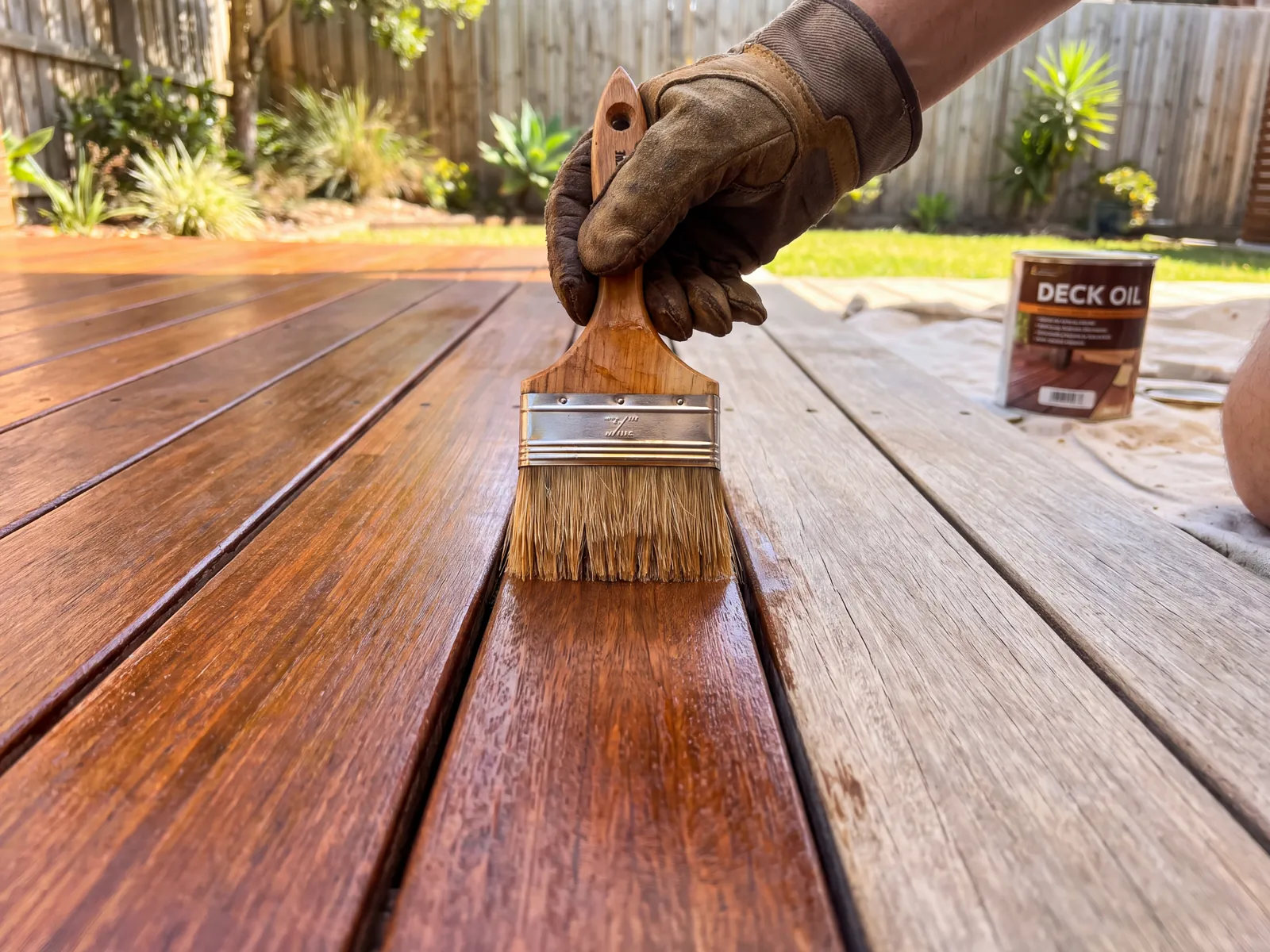
- Coat the full length of two or three boards at a time with an applicator pad or brush, so you always keep a wet edge.
- Brush out any puddles. Oil that doesn't soak in stays tacky and collects dirt.
- Apply the second coat when the product says. Two thin coats beat one heavy one.
- Keep people, pets and furniture off until it's dry.
New timber is a little different. New merbau in particular bleeds a lot of red-brown tannin the first few times it gets wet, and it can stain concrete, pavers and pool coping. We usually let a new deck weather for a few weeks, clean the tannin off, then oil it.
How often to oil a deck in Queensland
There's no single answer, because sun and weather exposure matter more than the calendar. As a rough guide from the decks we look after:
- Decks in full sun, especially north and west facing ones and pool decks: often every 6 to 12 months
- Partly covered decks: around once a year
- Fully covered verandahs and patios: often longer between coats
The water test beats any schedule. Sprinkle water on the sunniest boards. If it beads, the oil is still working. If it soaks straight in, it's time to recoat.
Signs your deck care is overdue
- Boards turning grey or silver, especially along the walking paths
- Water soaking straight in instead of beading
- Fine surface cracks along the grain, and split board ends
- Black or green mould spots, and boards that stay slippery after rain
- Splinters and a rough, furry surface
- Cupped boards that rock underfoot
Grey timber on its own is surface weathering and usually cleans up. Splits, cupping and soft spots mean water has been getting in for a while.
Extra care near the coast
On canal-front and beachside decks on the Gold Coast, rinse the deck with fresh water every few weeks to wash the salt off. Screws that rust or leave black streaks probably aren't stainless. When we replace boards or fixings on coastal decks, we use marine-grade stainless steel screws so the problem doesn't come back.
When to call a carpenter
A clean and oil is a good weekend job. Call a carpenter when boards are rotten, fixings are failing, the deck bounces or moves, or steps and balustrades feel loose. We do deck repairs and restorations on the Gold Coast and in Brisbane, from a few boards to a full restoration. If your timber fence or batten screens are looking tired too, we can look at them on the same visit.
If you'd like a second opinion, send us a few photos of your deck and roughly where you are. We'll tell you whether it just needs a clean and oil or some repairs first, and give you a clear quote.