
Repairs
Water-damaged ceiling repair: what to do, and in what order
A brown stain or bubbling paint on the ceiling means water has got in. Here's how to read the damage, what has to happen before any repair, and when a patch is enough.
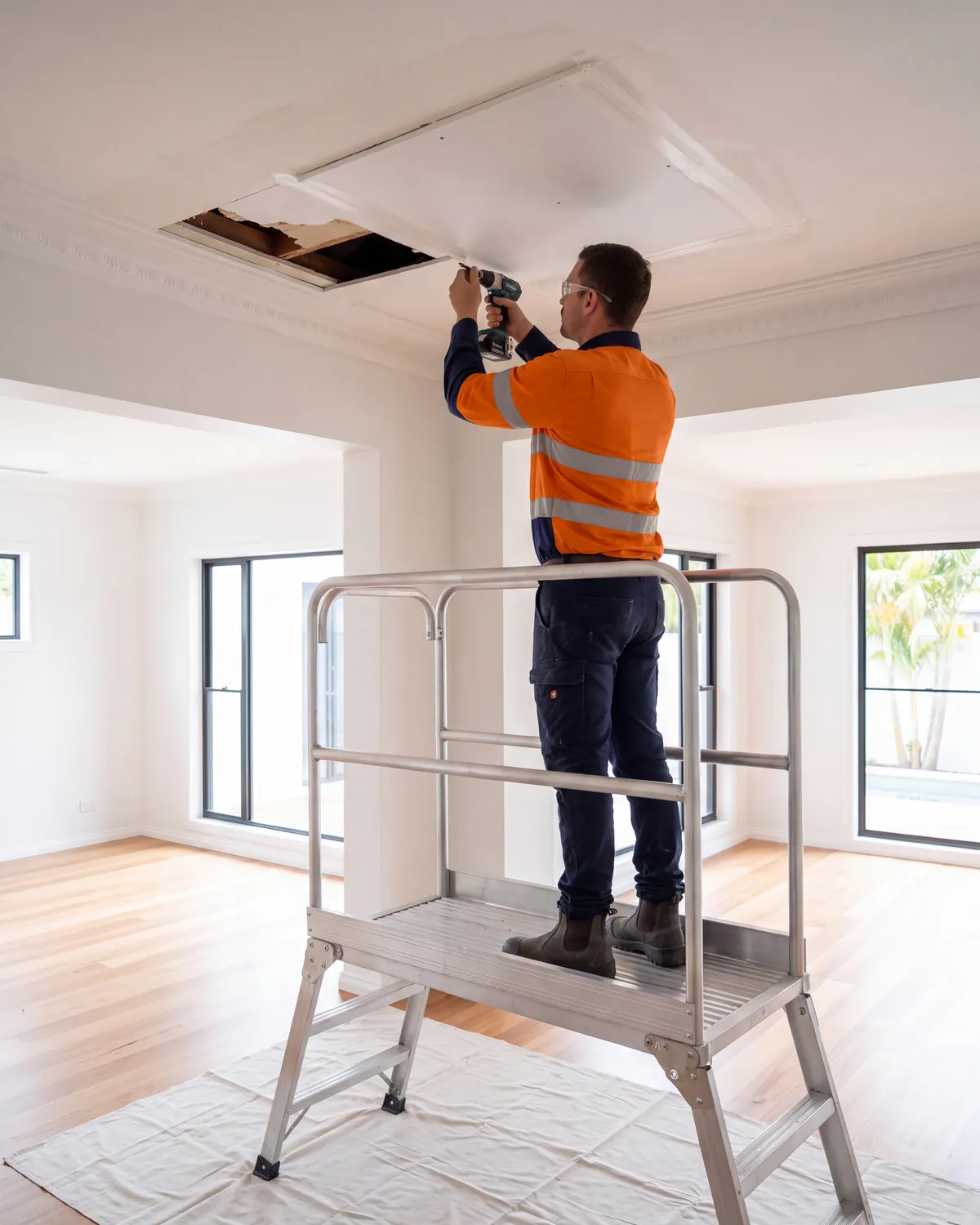
Water and plasterboard don't mix. A ceiling can look fine one week and have a brown ring, a bubble in the paint or a soft, drooping patch the next. The good news is that most water-damaged ceilings can be repaired without replacing the whole room. The catch is that the repair has to happen in the right order, and the first step isn't ours.
Step one: get the leak fixed
A new ceiling under an old leak will stain again, usually within the first big storm. Before anything is patched, the source has to be found and fixed by the right trade. We're carpenters, so we don't do plumbing or roofing, but the pattern of the stain often points to who you need.
- It only appears or grows after rain: usually the roof, flashings or a gutter overflowing in a summer storm. That's a job for a roofer or roof plumber.
- It's under a bathroom, laundry or kitchen, and shows up whether it rains or not: usually a pipe, a shower or a leaking fitting. Call a plumber.
- It's near an air conditioning unit or outlet: a blocked or overflowing condensation drain can drip onto the ceiling. Your air conditioning technician can check it.
Before anything is cleaned up, take a few photos of the stain, the room and any damage to furniture or flooring. If you end up making an insurance claim, those photos are useful.
Reading the damage
Stains
A yellow or brown ring, often with a darker edge, is the most common sign. The colour comes from dust and tannins in the roof space that the water carries through. A stain on its own doesn't mean the board is ruined. If the plasterboard is still hard and flat once it's dry, the ceiling can often be sealed and repainted.
Bubbling and peeling paint
Bubbles mean water has sat between the paint and the plaster. Sometimes it's only the paint and the top skin that have let go. Other times the paper face of the board has softened underneath. Pressing very gently around the edge of the bubble usually tells you which. If it feels firm, it's probably surface damage. If it gives, the board has taken on water.
Soft or drooping plasterboard
Plasterboard is gypsum between two layers of paper. Once the gypsum core gets soaked, it loses its strength and doesn't fully recover when it dries. Soft, crumbly or drooping board can't be saved with filler and paint. That section has to come out.
Keep safe while you wait
A ceiling that's holding water is heavy and can come down without much warning. If you can see a bulge, or water is still dripping:
- Keep people and pets out of the room, or at least out from under the damaged area.
- Move furniture and rugs out of the way and put a bucket under any drips.
- If water is near a light fitting, downlight or ceiling fan, turn the power off at the switchboard and call a licensed electrician.
- Don't poke or push up on a bulging ceiling. Leave it to a professional.
If the ceiling is sagging rather than just stained, our guide to sagging ceiling warning signs explains what to look for and when it's urgent.
Let it dry properly
Once the leak is fixed, the ceiling and the roof space above it need to dry out before new board goes up. Opening windows and running fans helps. How long it takes depends on how much water got in and the weather, and in a humid Queensland summer it can take longer than you'd expect. We check that the board around the damage is dry and hard, and that the framing above isn't still damp, before we start.
When a patch is enough, and when to replace a sheet
This is the question most people ask, and it comes down to the condition of the board, not the size of the stain.
Sealing and repainting is often enough when:
- The board is hard, flat and dry once the leak is fixed
- The damage is a stain or light bubbling with no softness underneath
- There's no mould in or behind the board
A section or full sheet needs replacing when:
- The board is soft, crumbly or has dropped between the battens
- The paper face has come away or the board has split
- The damage runs along a joint or reaches a sheet edge, where a patch would be weak
- Mould has grown through the board, not just on the paint
- The ceiling was wet for a long time, or got wet more than once
For a small, contained area, we cut back to the nearest framing members and fit a new piece of plasterboard. Where the damage spreads across a sheet, or a joint is affected, replacing the whole sheet usually gives a flatter, stronger result than several patches side by side.
A word on mould
Water in a ceiling plus Queensland humidity is a good recipe for mould. A few surface spots on a ceiling that's otherwise sound and dry can usually be cleaned off before the area is sealed and painted. Mould that has grown through the board, or a musty smell that hangs around after the area has dried, usually means the affected board has to come out. Wet insulation in the roof space can hold moisture and mould too, so we check above the ceiling and tell you if it needs replacing.
Don't scrub or sand mouldy plasterboard without protection. If the mould covers a large area, or anyone in the house has asthma or other breathing problems, talk to a mould specialist before the room is disturbed.
Older homes: check before anything is cut
Some older homes have ceiling sheets that contain asbestos. If your home is older and you're not sure what the ceiling is made of, don't cut, drill or sand it until it's been tested. We'll tell you before we start if we think the ceiling needs testing.
How we repair a water-damaged ceiling
- Confirm the leak has been fixed and the area is dry.
- Protect the floor and furniture, and check the framing in the roof space above.
- Cut out the damaged board back to sound plasterboard and framing.
- Fit and fix new plasterboard, then tape and set the joins in thin coats.
- Repair or replace any damaged cornice, matched to the existing profile as closely as we can.
- Seal with a stain-blocking primer and repaint, usually the whole ceiling so there's no visible patch.
That last step matters. Ordinary ceiling paint over a water stain often lets the brown ring bleed back through within weeks, and painting just the patch tends to leave a square you can see when the light hits it. If cracks are your main worry rather than water, our guide to plaster cracks and what they mean covers those.
Getting it fixed
We repair water-damaged ceilings and cornice across the Gold Coast and Brisbane through our ceiling repair service, and finish them off with patch and paint so the repair disappears.
Send us two photos, one close up of the damage and one of the whole room, and let us know whether the leak has been fixed. We'll tell you whether it looks like a seal and paint or a section replacement, and quote it.